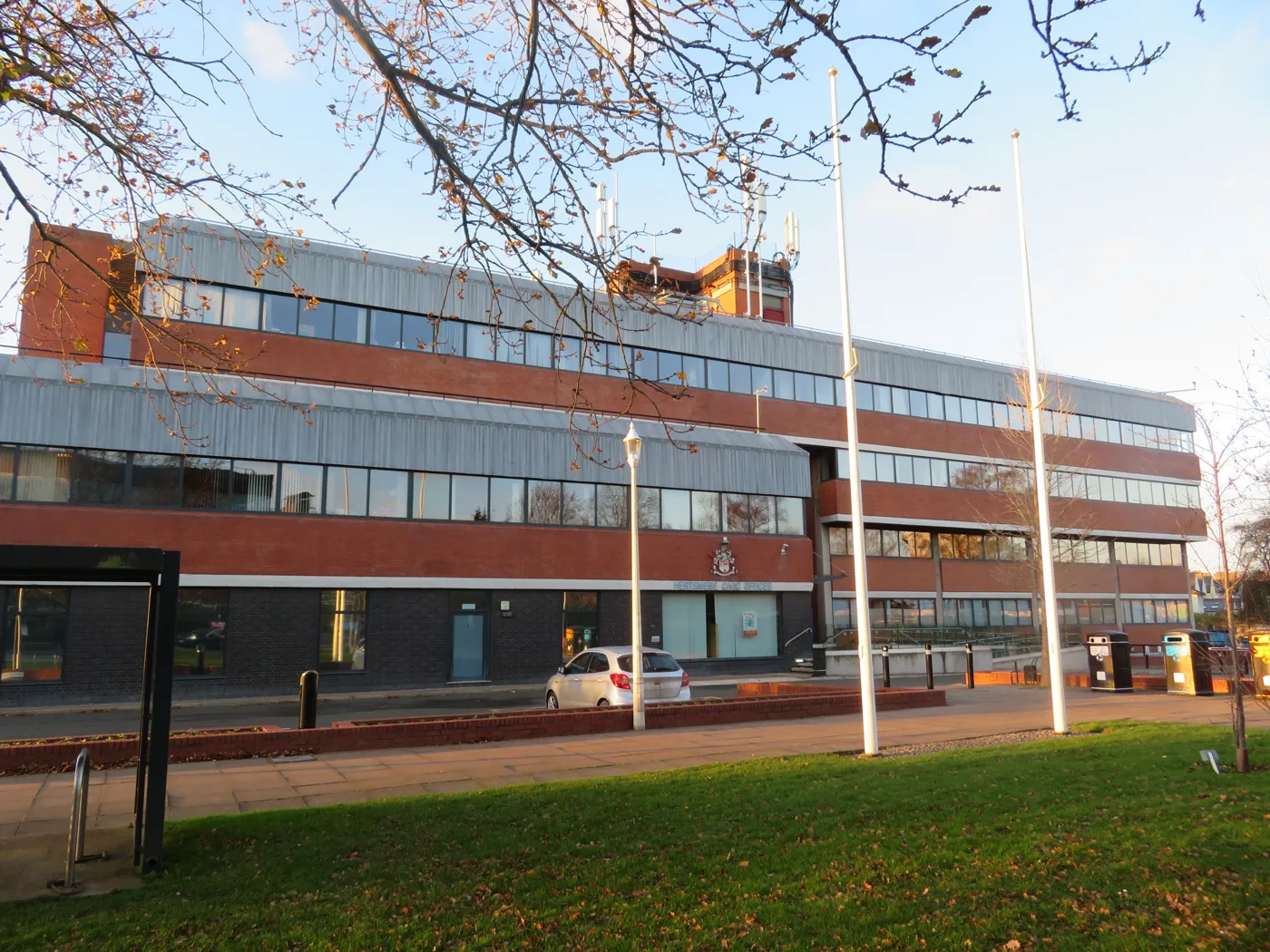

Hertsmere must plan for 16,160 homes, up from 266 a year to 1,010, and up to 8,000 could land in Borehamwood. The next draft is due before 31 December.
The number that decides most Hertsmere planning arguments for the next fifteen years is 16,160. That is the total number of new homes the borough’s emerging Local Plan has to provide for if it is to be found sound by a government inspector, and it is roughly four times what the current plan was built around.
Everything else follows from it: which fields come out of the green belt, why two supermarkets and three golf courses are on a list of candidate development sites, and why the council is working to a hard deadline of 31 December 2026. Here is where the plan has got to, what is in it for each town, and when you can say something about it.
The number, and where it came from
The Local Plan Hertsmere is still working to was written for 2012 to 2027 and set a requirement of 266 homes a year. The council’s own consultation document accepts that plan is now more than five years old and no longer up to date, particularly on housing.
Under the National Planning Policy Framework the starting point is the government’s standard method, and for Hertsmere that produces at least 1,010 additional homes a year. The council states plainly that there is no evidence of the exceptional circumstances that would justify any alternative approach.
On top of that comes a penalty. The latest Housing Delivery Test measurement found that developers here built out below 85% of their consents over the three-year reporting period, which triggers a 20% buffer on the five-year land supply. Annualised, that lifts the requirement to 1,212 homes a year for as long as delivery stays under 85%. The council assumes the buffer applies for at least the first five years of the plan, and that is how the headline figure is built: five years at 1,212 plus ten years at 1,010 comes to 16,160 homes.
Where the plan has got to
Hertsmere ran a six-week Regulation 18 consultation from 16 April to 29 May 2026, supported by seven public information events. That consultation has closed. The council is reviewing the responses and preparing the Regulation 19 Local Plan, which it intends to publish later in 2026.
The deadline is the thing to hold on to. To be examined under the existing plan-making system rather than the replacement the government is bringing in, the council must submit its plan for examination by 31 December 2026. That is why the Regulation 19 window will be narrow, and why the council said in its own FAQs that the spring consultation “represents the single best opportunity for interested parties to influence the shape of the emerging plan”.
At Regulation 19 the test changes. You are no longer being asked whether you like a site. You are being asked whether the plan is legally compliant and sound, meaning justified, effective, positively prepared and consistent with national policy. Comments go to the independent inspector, not to the council.
The council is also plainly aware of what happens to authorities that try to plan for less than their full need. Its consultation document records that the Secretary of State recently instructed another Hertfordshire authority to pause plan-making and justify an approach that left housing need unmet, and subsequently advised that local plans must “propose allocating all appropriate housing sites available that could contribute towards meeting housing need”.
What each town is being asked to take
The spatial strategy puts most of the growth, and specifically most of the first five years of it, into Borehamwood and Potters Bar, on the basis that they are the borough’s largest settlements with the most existing infrastructure. If every candidate site were allocated, the council’s own figures are:
| Town | Homes | Employment floorspace | Approach |
|---|---|---|---|
| Borehamwood | up to 8,000 | 75,000 sq m | Town centre regeneration and intensification, plus carefully planned edge-of-town sites |
| Potters Bar | up to 5,000 | 217,000 sq m | Redevelopment within the urban area, plus land around the town |
| Bushey | up to 3,000 | 75,000 sq m | Optimising sites inside the existing urban area |
| Radlett | up to 2,900 | not stated | Modest and incremental: previously developed land, small infill, under-used land |
| Shenley and the villages | no allocation | not stated | Generally not considered to support sustainable development |
Those four figures add up to 18,900, and the council puts the full candidate long list at at least 18,943 dwellings against the 16,160 target. That gap matters: about one home in seven of the current candidate capacity will not be needed, so the Regulation 19 draft will be shorter than the one consulted on. As the FAQs put it, “final figures are expected to be lower than this once site allocations are finalised”.
Two things stand out from the table. Potters Bar’s employment figure is nearly three times Borehamwood’s, at 217,000 square metres, which is a substantially bigger change to that town’s economy than the housing number alone suggests. And Radlett, the smallest town, is being asked for almost as much as Bushey, which has three times the population.
The green belt
Hertsmere is ringed by Metropolitan Green Belt, and the council’s stated approach is to maximise growth inside the urban areas and “limit the release of green belt land for development as far as possible”. It then says the quiet part out loud: “in Hertsmere’s case, the scale of housing need means that some release of green belt land is necessary to ensure those needs can be met in full.”
That is not a discretionary choice the council is making. The National Planning Policy Framework allows green belt boundaries to be reviewed through the local plan process where exceptional circumstances are demonstrated, and a fourfold increase in the housing requirement is what the council is putting forward as the exceptional circumstance.
The biggest sites on the list
None of these are allocations yet. They are candidate sites, assessed as fitting the emerging strategy, with an indicative capacity attached. The largest in the Regulation 18 document:
| Site | Town | Indicative homes |
|---|---|---|
| Land at Mutton Lane (north) | Potters Bar | 1,875 |
| Land at Elstree Road (south) | Bushey | 1,300 |
| The Hertsmere Golf Course | Elstree and Bushey | 1,073 |
| Home Farm | Radlett | 1,040 |
| Land north of Watford Road and east of Kemprow | Radlett | 972 |
| Land rear of Farm Way (north) | Bushey | 802 |
| Tesco Superstore, Mutton Lane | Potters Bar | 588 |
| Borehamwood Town Centre Retail Park | Borehamwood | 501 |
| Tesco Foodstore, Shenley Road | Borehamwood | 468 |
| Land south of Watford Road and west of New Road | Radlett | 450 |
| Former Potters Bar Golf Course | Potters Bar | 400 |
| Canada Life House, High Street | Potters Bar | 369 |
| Bushey Golf and Country Club | Bushey | 286 |
Read that list and the strategy becomes concrete. Three golf courses are on it. Two Tesco stores are on it, both proposed for residential-led redevelopment above or in place of the shops. The largest single site, at Mutton Lane in Potters Bar, is described in the document as a strategic urban extension of 1,875 homes with town centre, social infrastructure and employment uses attached, on land whose only noted planning history is archaeological and the setting of listed farm buildings at Mimms Hall.
Two live applications worth watching
Land rear of Farm Way, Bushey. This 34.86-hectare site off Little Bushey Lane already has live applications on it. Application 25/0972/FULEI is a hybrid, residential-led mixed-use scheme: the detailed part covers phased housing, flexible non-residential space, a community park and access from Little Bushey Lane, and the outline part covers up to 700 dwellings, a care home of up to 70 beds, land reserved for a primary school and around 1,701 square metres of non-residential floorspace. A separate reserved matters application, 25/1811/REM, covers 27 dwellings under an earlier permission. The candidate site as a whole is put at 802 homes. The land is a local wildlife site containing historic parkland, with gas mains across it.
Land south of Allum Lane, Elstree. Application 24/0442/FUL is live and pending determination: an integrated retirement community of apartments and bungalows with a facilities building, plus a replacement doctors’ surgery and a new access off Allum Lane. The council’s own site assessment notes the scheme could secure the relocation and re-provision of the NHS Shopwick Surgery from Elstree Village. Indicative capacity is 241 homes on 10.46 hectares.
What has actually been built
Against those numbers, the council’s own recent delivery is small but worth recording. Three four-bedroom affordable homes on Caishowe Road in Borehamwood were completed on 2 July 2026, two of them extensively adapted for residents with complex physical disabilities, with lifts, hoists and accessible bathrooms. The scheme won Gold in the Best New Social Housing (Small Scale) category at the Hertfordshire Building Control Awards 2026 and was delivered with construction partners Ermine and Pellings and the council’s own company, Hertsmere Living Limited.
Three homes against a target of 1,212 a year is the gap the Local Plan exists to close, and it is worth being honest that almost all of that will be built by private developers on the sites above, not by the council.
The council that adopts this plan may not exist for long
On 16 July 2026 the government confirmed it will create four unitary councils in Hertfordshire, subject to parliamentary approval. From 1 April 2028, Hertsmere Borough Council, Three Rivers District Council and Watford Borough Council will be replaced by a single South West Hertfordshire authority. Elections to the new councils take place in May 2027, with those councillors operating in shadow form until the handover.
The sequencing matters for planning. The Local Plan has to be submitted for examination by December 2026, examined during 2027, and will in all likelihood be inherited and implemented by a council that has not yet been elected. Hertsmere’s leader, Councillor Jeremy Newmark, welcomed the decision, saying that joining with Watford and Three Rivers “creates an exciting opportunity” to build on the area’s film and television industry.
What to do about it
- Watch for the Regulation 19 publication later in 2026. It is the last formal comment window before the plan goes to the Planning Inspectorate, and it will be short.
- Check whether a site near you is on the candidate list. If it is, the Regulation 19 draft is where you find out whether it survived.
- Frame comments on soundness, not preference. At Regulation 19 the inspector is testing whether the plan is justified, effective, positively prepared and consistent with national policy. “I do not want this” is not a soundness argument; “the evidence base does not support this capacity on this site” is.
- Allocation is not permission. A site in the plan still needs a planning application, and the detail of access, layout, density and infrastructure is decided then. But refusing an allocated site later is much harder, which is why this stage is the one that counts.
- Ordinary applications carry on regardless. Individual schemes are being decided every week while the plan is written. Hertsmere’s planning register is online.
Frequently asked questions
How many new homes does Hertsmere have to build?
At least 16,160 over the plan period. That comes from the government’s standard method figure of 1,010 homes a year, with a 20% Housing Delivery Test buffer taking it to 1,212 a year for the first five years. The adopted plan the borough still works to was built around 266 homes a year.
How many new homes are proposed for Borehamwood?
Up to 8,000, plus 75,000 square metres of employment floorspace, if every candidate site in the Regulation 18 consultation were allocated. The council has said final figures will be lower. Borehamwood carries the largest share of the borough’s growth, focused on town centre regeneration and some edge-of-town sites.
When is the next Hertsmere Local Plan consultation?
The Regulation 19 consultation, expected later in 2026. The Regulation 18 consultation ran from 16 April to 29 May 2026 and has closed. The council must submit the plan for examination by 31 December 2026.
Will Hertsmere build on the green belt?
Yes, in part. The council’s stated approach is to limit green belt release as far as possible, but its consultation document says directly that “the scale of housing need means that some release of green belt land is necessary” to meet the requirement in full.
What is happening to Hertsmere Borough Council?
It is being abolished on 1 April 2028 and merged with Three Rivers and Watford into a new South West Hertfordshire unitary council. The government confirmed the four-unitary model for Hertfordshire on 16 July 2026, with elections to the new authorities in May 2027.
Are the candidate sites already approved?
No. They are a long list of sites assessed against the emerging strategy, and the list is deliberately larger than the target: 18,943 potential dwellings against a requirement of 16,160. About one home in seven of that capacity will not be needed.
Related
- Borehamwood house prices: the market these 16,160 homes are meant to relieve, town by town.
- Trains to London from all four Hertsmere stations: the commuter geography the spatial strategy is built around.
- Roadworks, parking and travel in Hertsmere.
Sources
- Hertsmere Local Plan Draft Regulation 18 Consultation Document, April 2026 for the 266, 1,010, 1,212 and 16,160 figures, the Housing Delivery Test buffer, the Secretary of State intervention note and the candidate site capacities and planning statuses.
- Hertsmere Borough Council, New Local Plan Frequently Asked Questions for the per-town capacity figures, the 18,943 candidate total and the green belt position.
- Hertsmere Borough Council, Draft Local Plan 2026 for the consultation dates, the Regulation 19 timetable and the 31 December 2026 submission deadline.
- Hertsmere Borough Council, Government announces four unitary authorities in Hertfordshire, 16 July 2026.
- Hertsmere Borough Council, Award winning affordable homes completed in Borehamwood, 2 July 2026.
- Hertsmere Borough Council, Local Plan evidence base for the full set of supporting studies.
We will update this page when the Regulation 19 Local Plan is published and the final site allocations are known.
Have your say